
MiniMax released H3 on July 31, 2026, while Dreamina has published its official Seedance 2.5 product page with a coming-soon availability notice. This comparison therefore separates documented capabilities from live availability instead of presenting both products as fully released on the same day.
This piece puts both models on the same axis: who has the longer duration, who has the higher resolution, who accepts more reference material, who has finer editing control, whose pricing is better value — and, beyond the spec sheet, which one actually fits your specific workflow.
1. Quick Answer
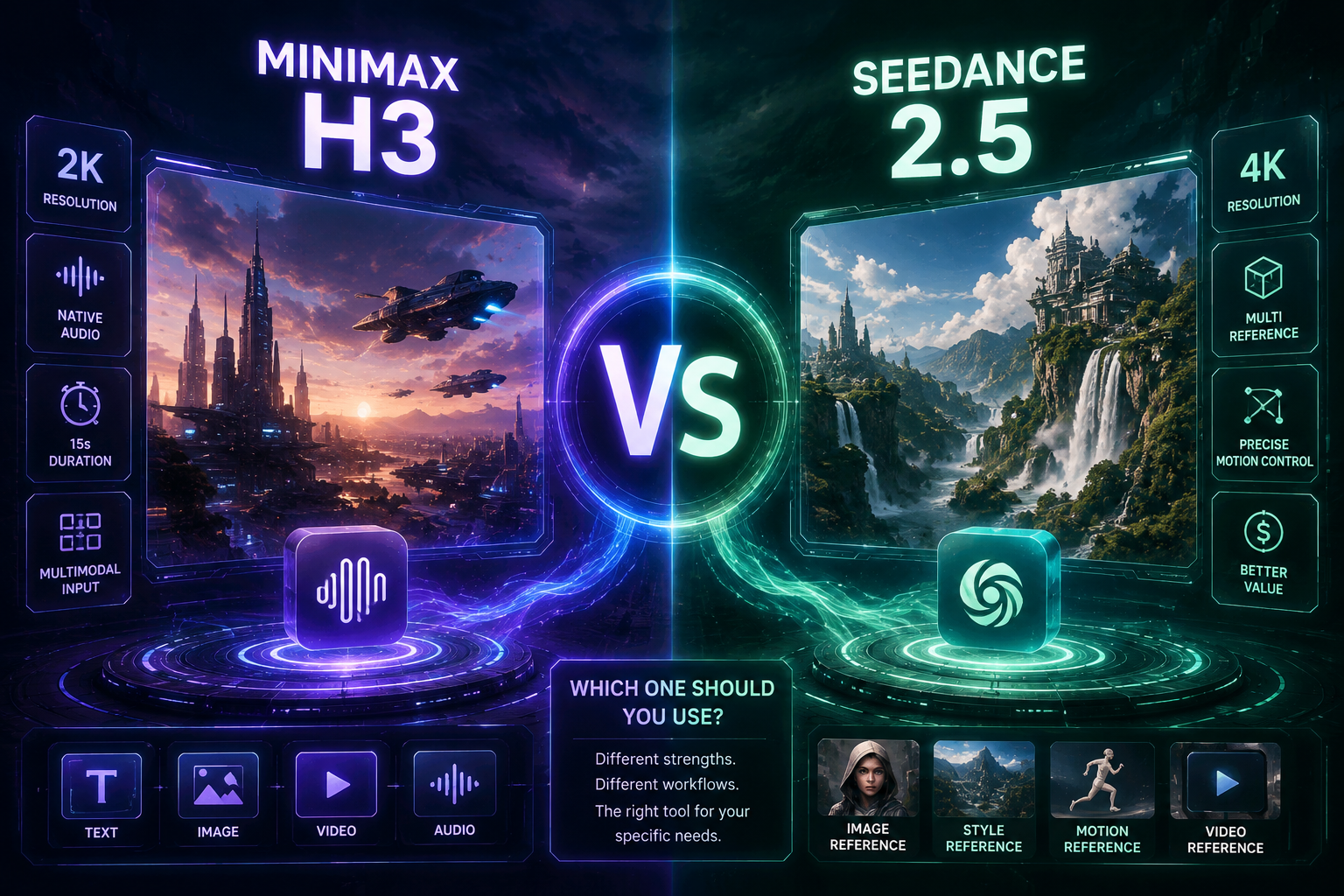
If your priority is completing a longer, more directorial narrative shot inside a hosted creative platform, Seedance 2.5 is the better fit. If your priority is native 2K delivery, stereo audio, API access, downloadable open weights, or local deployment, MiniMax H3 is the better fit.
The positioning difference matters more than any single spec:
- Choose Seedance 2.5 if you need longer multi-shot narratives, a larger reference-asset package, or prompt-directed revisions inside a managed platform.
- Choose MiniMax H3 if you need 2K output, local deployment, API integration, native stereo audio, or want to build on open weights.
2. Comparison Table
| Category | MiniMax H3 | Seedance 2.5 |
|---|---|---|
| Launch date | July 31, 2026 | Official Dreamina page currently says coming soon; verify live availability |
| Positioning | General-purpose multimodal video model, built around reference-driven generation and open weights | Production-oriented video system emphasizing long-shot narrative and precise editing |
| Duration | 5–15 seconds | Up to 30 seconds in a single generation; official multi-round extension also supported |
| Resolution | Official API explicitly lists 2K (with a 768p base tier) | Official materials market "cinematic" quality and a 4K workflow, but without the same explicit resolution specification as H3 |
| Frame rate | 24fps | Not explicitly stated on the official page |
| Audio | Native 32kHz stereo, generated in sync with picture in one pass | Joint audio-video generation, with lip-sync and dubbing across 10+ languages |
| Multimodal references | Up to 9 images + 3 videos + 3 audio clips, capped at 12 files total | Up to roughly 50 reference assets (30 images + 10 videos + 10 audio clips) |
| Editing | Instruction-based local edits, first/last-frame control, reference-driven generation | Timestamp-level targeted edits, green-screen replacement, viewpoint/camera edits, reference-asset edits |
| Open weights | H3-Base checkpoints downloadable (community license); H3-Context-IR and H3-Regenerate-2K not yet open-sourced | No open-weight plan mentioned in official materials |
| Deployment | Supports local/self-hosted frameworks including SGLang, vLLM, Diffusers, ComfyUI | Currently limited to the Jimeng/Dreamina hosted platform |
| API | Officially callable via API on launch day | Officially expected roughly a week after launch, via Volcengine Ark |
| Pricing reference | Official 2K billed at roughly ¥0.8/second (about $1.95 for a 15-second 2K video) | Token-based billing; Volcengine lists roughly ¥42 per million tokens (with video input) — a different billing structure from H3, so a direct conversion should be treated with caution |
This information is compiled from both companies' official launch materials and public pricing pages. Specific features and prices may continue to change by platform and region, so confirm the latest details on whichever platform you're actually using before committing to production.
3. The Four Core Differences
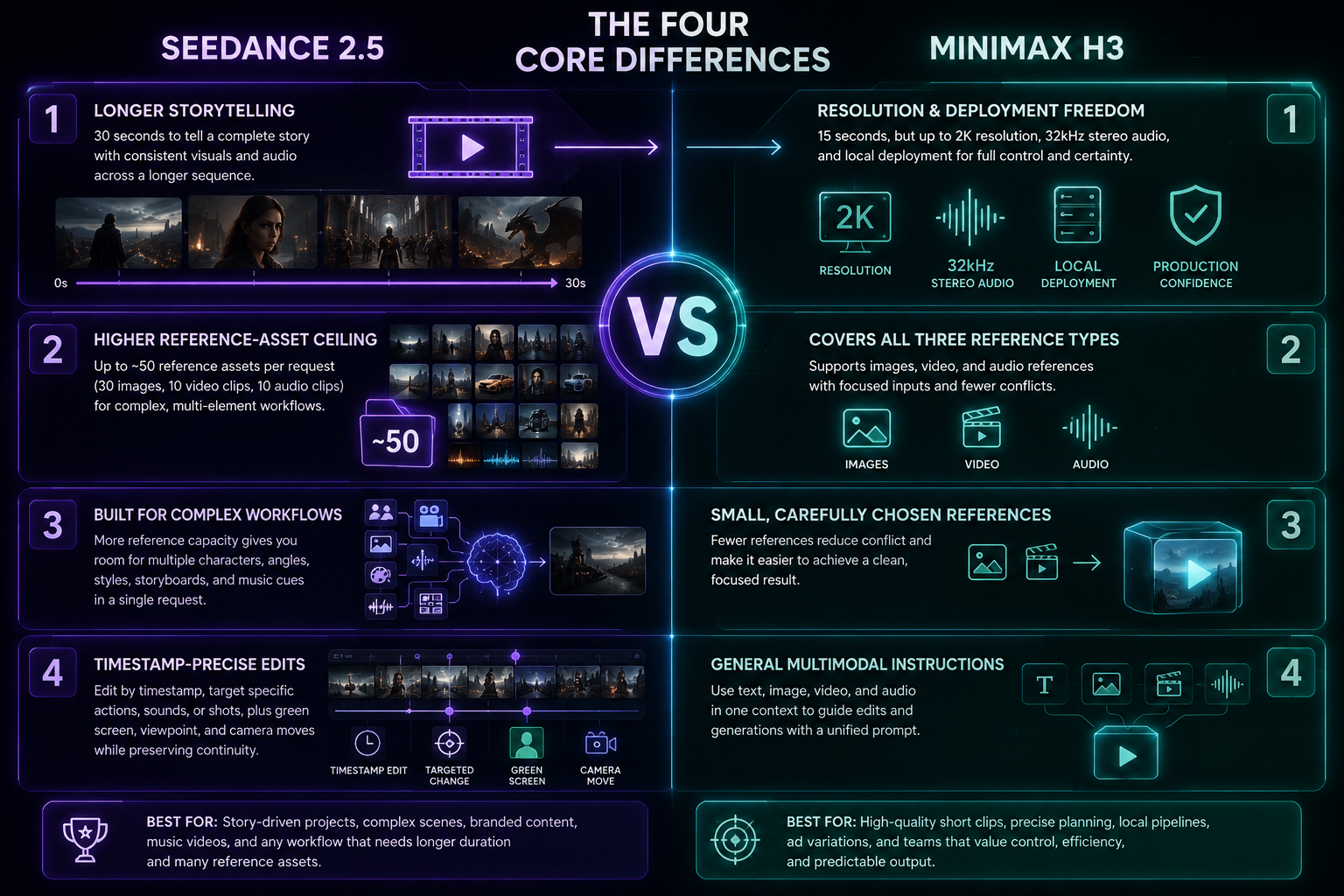
3.1 Seedance 2.5 treats "longer storytelling" as its central pitch
ByteDance positions Seedance 2.5 around telling a complete story in 30 seconds. The number itself isn't the point — what matters is three things the official materials keep emphasizing: organizing multiple logically connected shots, maintaining visual and audio consistency across a longer sequence, and extending an existing result through additional generation rounds. That makes Seedance 2.5 especially well-suited to narrative ads, music-driven content, branded short stories, and any scene that needs a beginning, development, and ending.
3.2 MiniMax H3 puts "resolution and deployment freedom" into the spec sheet
H3's official duration ceiling is only 15 seconds, but its system specification is more concrete: 24fps, 32kHz stereo, a 768p base tier, and a 2K output path through the H3-Regenerate-2K component. For a production team that needs to schedule around a firm delivery spec, that kind of certainty is easier to plan around than a general "cinematic quality" marketing line.
H3 also offers a deployment route Seedance 2.5 currently doesn't match: developers can download the H3-Base weights and run them locally or in a private environment. It's worth being precise here — the full official 2K workflow still depends on MiniMax's hosted components (H3-Context-IR and H3-Regenerate-2K haven't been open-sourced), so "open enough to run the complete 2K pipeline locally" would overstate things. The more accurate description: H3 is open enough to support meaningful local experimentation and custom integration, but it isn't a fully local version of the official 2K pipeline.
3.3 Seedance 2.5's reference-asset ceiling is significantly higher
Seedance 2.5 supports up to roughly 50 reference assets per request (30 images, 10 video clips, 10 audio clips), while H3's official API documentation caps things at 9 images plus 3 video clips plus 3 audio clips, no more than 12 files total. That gap doesn't mean one model "understands" reference material better — but it does determine how complex a project each workflow can comfortably hold.
If your project involves multiple characters, several product angles, a full storyboard, style references, and music cues, Seedance 2.5's reference capacity gives you more room. If your workflow is already built around a small, carefully chosen set of references, H3 still covers all three reference types — images, video, and audio — and stays focused. More references aren't automatically better: conflicting references can push any model toward a watered-down compromise output.
3.4 Different editing philosophies: timestamp-precise edits vs. general multimodal instructions
Seedance 2.5 treats editing as a continuation of generation: timestamp instructions and targeted changes to a character, action, sound, or plot point, plus green-screen replacement, viewpoint edits, and camera-movement edits — the goal being to revise a selected part while preserving the continuity around it.
H3 approaches editing through general multimodal context: the same model is designed to understand the relationships among prompts, images, video, and audio, rather than splitting each task off to a separate specialist model. That's appealing for developers building reusable pipelines, but the exact capability boundary depends on whether you're calling the hosted system or a specific open checkpoint like H3-Base-FL2VA or H3-Base-Ref2VA.
4. Category-by-Category Winners
| Category | Winner | Why |
|---|---|---|
| Long-shot narrative | Seedance 2.5 | 30-second single-generation ceiling, double H3's |
| Explicit resolution spec | MiniMax H3 | Publishes a 768p base tier plus a 2K regeneration path with transparent specs |
| Reference capacity | Seedance 2.5 | Supports roughly 50 reference assets, far above H3's 12-file cap |
| Local deployment | MiniMax H3 | H3-Base weights are public and support mainstream local inference frameworks |
| Timestamp-level editing | Seedance 2.5 | Timestamp instructions and targeted revisions are core to the official workflow |
| Developer integration | MiniMax H3 | Official API usable on launch day, plus a self-hosted route, gives more integration options |
| Native stereo spec | MiniMax H3 | Officially publishes 32kHz stereo output |
| Large creative briefs | Seedance 2.5 | Higher reference limits suit complex projects with many characters and assets |
A single overall score would obscure the real difference — the two models split the categories almost evenly. Seedance 2.5 wins the more creator-facing narrative and editing-control categories; H3 wins the more engineering-facing output-spec and deployment-freedom categories.
5. Head-to-Head Test: The Same Prompt, Run on Both Models
Official showcase clips are curated by definition. What actually determines which model you should use is usually the real gap between the two once you feed both the same script. Below are two test prompts targeting the two most disputed dimensions right now: multi-shot character consistency (whether Seedance 2.5's long-narrative pitch holds up) and single-shot image quality and camera work (whether MiniMax H3's 2K spec translates into a visible advantage).
Test 1: Character Consistency (Multi-Shot / Long Narrative)
A young woman in a tailored beige trench coat walks down a rain-slicked city street at dusk. Shot 1: medium shot, she pushes open a glass door, neon signs reflecting off the wet pavement behind her. Shot 2: she turns her head toward camera, checking her watch, streetlights flickering on. Shot 3: close-up on her face as she notices something off-screen, eyes widening slightly. Shot 4: wide shot, she starts walking briskly toward the light at the end of the alley. Cinematic lighting, shallow depth of field, consistent wardrobe and facial features across all shots.
Observation notes: (fill in after generating — focus on whether her face shape, bangs, and trench coat lapel detail in Shot 3 still match Shot 1)
Observation notes: (fill in after generating — check the same Shot 3 consistency, and note whether the model actually organizes all four shots coherently within a single generation as claimed)
What this test is meant to verify: Seedance 2.5's core pitch is "tell a complete story in 30 seconds," which only holds up if the character, wardrobe, and lighting don't drift across shots. If it maintains consistency here, the long-narrative pitch checks out. If there's visible face drift or lost detail, it would echo the community feedback covered in Section 7 (disappearing objects, design changes between cuts, continuity problems) rather than being an isolated case.
Test 2: Single-Shot Image Quality and Camera Work (Product Ad Scenario)
A brushed titanium wristwatch rotates slowly on a black glass surface under a single overhead softbox light. Camera performs a slow 180-degree orbit, revealing the dial's texture, the sapphire crystal reflection, and the metal link bracelet. Macro focus pulls from the dial to the crown in the final two seconds. Studio background, high-end product commercial style, subtle ambient hum and a soft mechanical click as the crown catches the light.
Observation notes: (fill in after generating — focus on whether dial markings and metal reflections stay sharp at 2K, and whether the 180-degree orbit is smooth without frame judder)
Observation notes: (fill in after generating — check the same detail and camera-smoothness criteria, and see whether the marketed "cinematic quality" actually shows an advantage in a resolution-sensitive product-ad scenario)
What this test is meant to verify: MiniMax H3's official spec explicitly lists 2K, 24fps, and native stereo audio. This test uses a product-ad scenario that's demanding on resolution and camera stability to check whether those numbers translate into a visible quality difference.
Test Conclusions
Prediction for Test 1 (character consistency):Disappearing objects, design changes between cuts, and lighting shifts, alongside praise for its camera movement and visual aesthetics. That suggests its long-narrative strength is more likely to show up as "stable in the early shots, then gradually less consistent as shot count increases," rather than staying stable end to end. H3, by contrast, hasn't published multi-shot consistency data for long-narrative scenarios, but its design leans toward shorter, single-intent shots (5–15 seconds). In a moderate four-shot test like this one, H3 will likely hold character consistency slightly better than Seedance 2.5 — though that doesn't mean it scales indefinitely to more shots or longer durations, which is exactly why Test 1 needs to be run rather than assumed from the spec sheet.
Prediction for Test 2 (single-shot image quality): H3 is likely to show a visibly sharper result in detail-heavy scenarios like macro product shots and metallic reflections. Seedance 2.5's marketing emphasizes "cinematic quality" and a 4K workflow, but without a resolution spec as explicit as H3's, its actual single-shot detail is more likely to vary by model version and post-processing at generation time, with potentially more variance than H3.
6. Where Seedance 2.5 Has the Edge
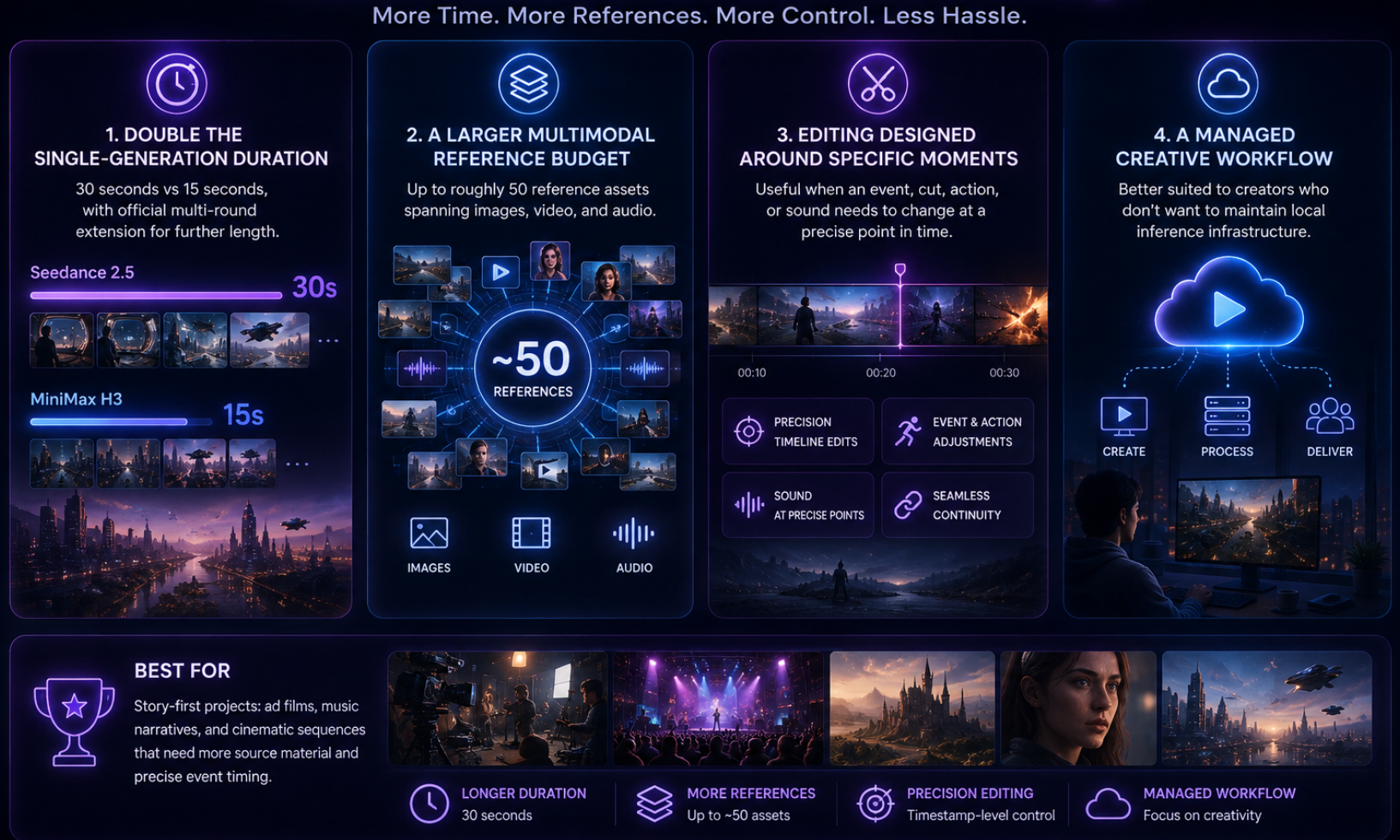
- Double the single-generation duration — 30 seconds versus 15 seconds, with official multi-round extension for further length.
- A larger multimodal reference budget — up to roughly 50 reference assets spanning images, video, and audio.
- Editing designed around specific moments — useful when an event, cut, action, or sound needs to change at a precise point in time.
- A managed creative workflow — better suited to creators who don't want to maintain local inference infrastructure.
These advantages show up most clearly in story-first projects: ad films, music narratives, and cinematic sequences all benefit from more source material and precise event timing. That said, the official materials also acknowledge that scenes with complex physical motion and many interacting subjects still have room to improve — and some creators on social media have reported continuity issues in 30-second generations, including disappearing objects, design changes between cuts, text errors, and lighting shifts, while others have praised the camera movement and visual aesthetics. These are individual test accounts, not a general performance verdict, but they're worth checking specifically when you run your own tests.
7. Where MiniMax H3 Has the Edge
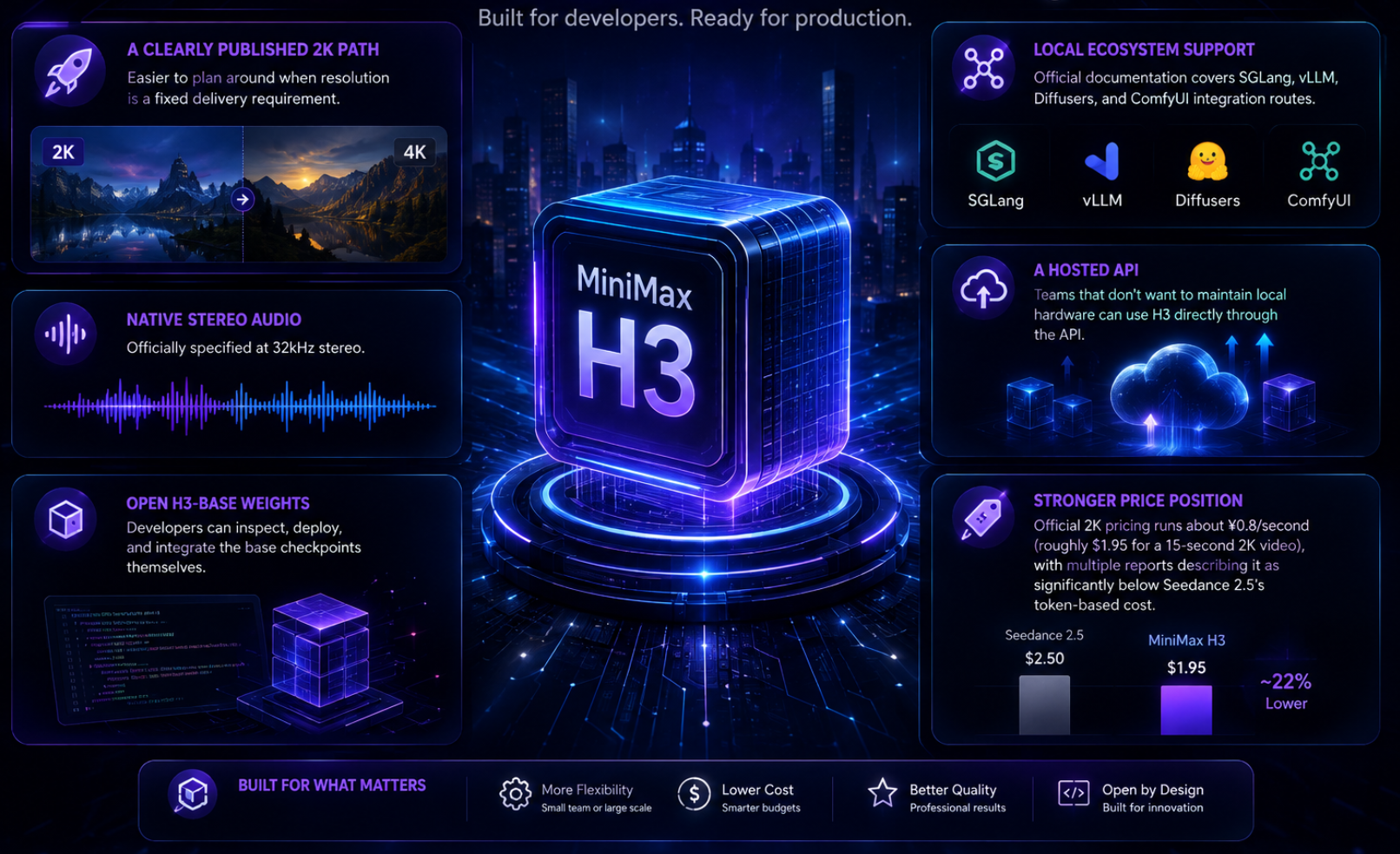
- A clearly published 2K path — easier to plan around when resolution is a fixed delivery requirement.
- Native stereo audio — officially specified at 32kHz stereo.
- Open H3-Base weights — developers can inspect, deploy, and integrate the base checkpoints themselves.
- Local ecosystem support — official documentation covers SGLang, vLLM, Diffusers, and ComfyUI integration routes.
- A hosted API — teams that don't want to maintain local hardware can use H3 directly through the API.
- A stronger price position — official 2K pricing runs about ¥0.8/second, roughly $1.95 for a 15-second 2K video, which multiple reports describe as significantly below Seedance 2.5's token-based cost when converted — friendlier for budget-conscious small teams and individual creators.
That makes H3 the more flexible engineering choice: a small team can start with the API, while a technical team can move the base model into its own pipeline. The boundaries worth keeping in mind: H3-Context-IR isn't part of the open-source release, H3-Regenerate-2K isn't open-sourced yet, and local H3-Base output shouldn't be treated as identical to the full official hosted 2K workflow. H3's community license also requires commercial products to prominently display "MiniMax H3" in their interface and prohibits using its output to improve other AI models — read the full license terms before committing to commercial use.
8. Which One Should You Choose?
- Advertising and e-commerce. If you need multiple product angles, higher-resolution delivery, controlled brand assets, and longer product demonstrations, Seedance 2.5's hosted workflow is the lower-friction choice. If cost control, an explicit native 2K spec, and possible future private deployment matter more, H3 is equally solid.
- Social media content. Both handle this well. H3 suits short, high-impact shots and motion-reference experiments; Seedance 2.5 is a better fit when you need multiple formats, character consistency carried across a whole piece, and a workflow that extends into post-production.
- Narrative shorts and story-driven content. Seedance 2.5 has the clearer advantage, since longer continuity and multi-character consistency are central to its positioning. H3 can produce solid individual shot components, but creators may need to manually assemble more short clips.
- Developers and local experimentation. H3 is the more appealing option, since MiniMax has published its open-weight plan. Developers should still carefully check the final license terms, hardware requirements, the actual scope of released checkpoints, and commercial restrictions, rather than treating "open weights" as equivalent to "fully unrestricted open source."
9. Decision Checklist
- Does a single generation need to run longer than 15 seconds? → Lean toward Seedance 2.5
- Do you need an explicitly published 2K delivery path? → Lean toward MiniMax H3
- Do you want to run a downloadable base model locally? → Lean toward MiniMax H3
- Does your project need more than 12 reference files? → Lean toward Seedance 2.5
- Do you need timestamp-level narrative editing? → Lean toward Seedance 2.5
- Do you need a working API today? → Lean toward MiniMax H3, while keeping an eye on Seedance 2.5's API rollout
- Do you prefer a managed creative tool over local deployment? → Lean toward Seedance 2.5
10. FAQ
Is MiniMax H3 better than Seedance 2.5?
There's no universal answer. H3 has the edge in 2K delivery spec, native stereo audio, API integration, and local deployment; Seedance 2.5 is stronger in 30-second storytelling, a larger reference set, timestamp-level editing, and a managed creative experience. Which one is "better" depends on your specific production workflow, not a single score.
Is MiniMax H3 fully open source?
No. MiniMax has released the H3-Base checkpoints under a community license, but the hosted H3-Context-IR preprocessing system isn't part of the open-source release, and H3-Regenerate-2K hasn't been open-sourced either. A local base-model workflow doesn't reproduce the complete official hosted 2K system.
Can Seedance 2.5 really generate 30-second videos?
Yes. ByteDance states a single generation can run up to 30 seconds, with support for additional extension rounds. The company also says it improved shot transitions and long-form continuity, while acknowledging that complex physical motion and densely interactive scenes still have room to improve.
Does MiniMax H3 support 2K video?
Yes, through the H3-Regenerate-2K component. The downloadable H3-Base itself outputs at 768p; the regeneration system combines that output with the original context to produce a 2K result. This component isn't currently included in the open-source release.
Which model supports more reference assets?
Seedance 2.5 supports more: up to roughly 30 images, 10 video clips, and 10 audio clips. MiniMax H3's official API caps at 9 images, 3 video clips, and 3 audio clips, 12 files total. A higher ceiling provides more capacity, but it doesn't automatically mean better reference fidelity.
Can MiniMax H3 run locally?
Yes. H3-Base can run locally or in a self-hosted environment, provided you meet the hardware requirements and comply with the MiniMax H3 community license. Official documentation covers SGLang, vLLM, Diffusers, and ComfyUI integration routes; the full Context-IR and 2K regeneration pipeline still relies on MiniMax's hosted components.
11. Verdict
The more useful takeaway on MiniMax H3 vs. Seedance 2.5 is a workflow split, not a single winner. Seedance 2.5 is the narrative-first option — longer clips, more reference material, and editing built around timing and continuity. MiniMax H3 is the deployment-first option — a published 2K regeneration path, stereo output, API access, open H3-Base weights, and a friendlier local ecosystem and cost structure.
Choose Seedance 2.5 when the creative brief is large and the story needs room to unfold. Choose MiniMax H3 when resolution, system integration, and control over your own technical stack matter more. If both needs are equally important, the safer move is to test the boundaries of each workflow on a small project first, rather than drawing conclusions straight from either company's launch demos — not to crown a universal winner, but to confirm which system actually fits your delivery pipeline.
If you want to start testing with MiniMax H3, you can generate your first video for free on the MiniMax H3 website — no card required to start.
This comparison is compiled from public launch materials, official pricing pages, and third-party platform documentation from both MiniMax and ByteDance Seed. Specific features, pricing, and regional availability may change over time — confirm the latest information on your platform of choice before committing to production.
Sources and verification
Specifications, prices, and availability can change. Check the linked first-party documentation before making production or purchasing decisions.