
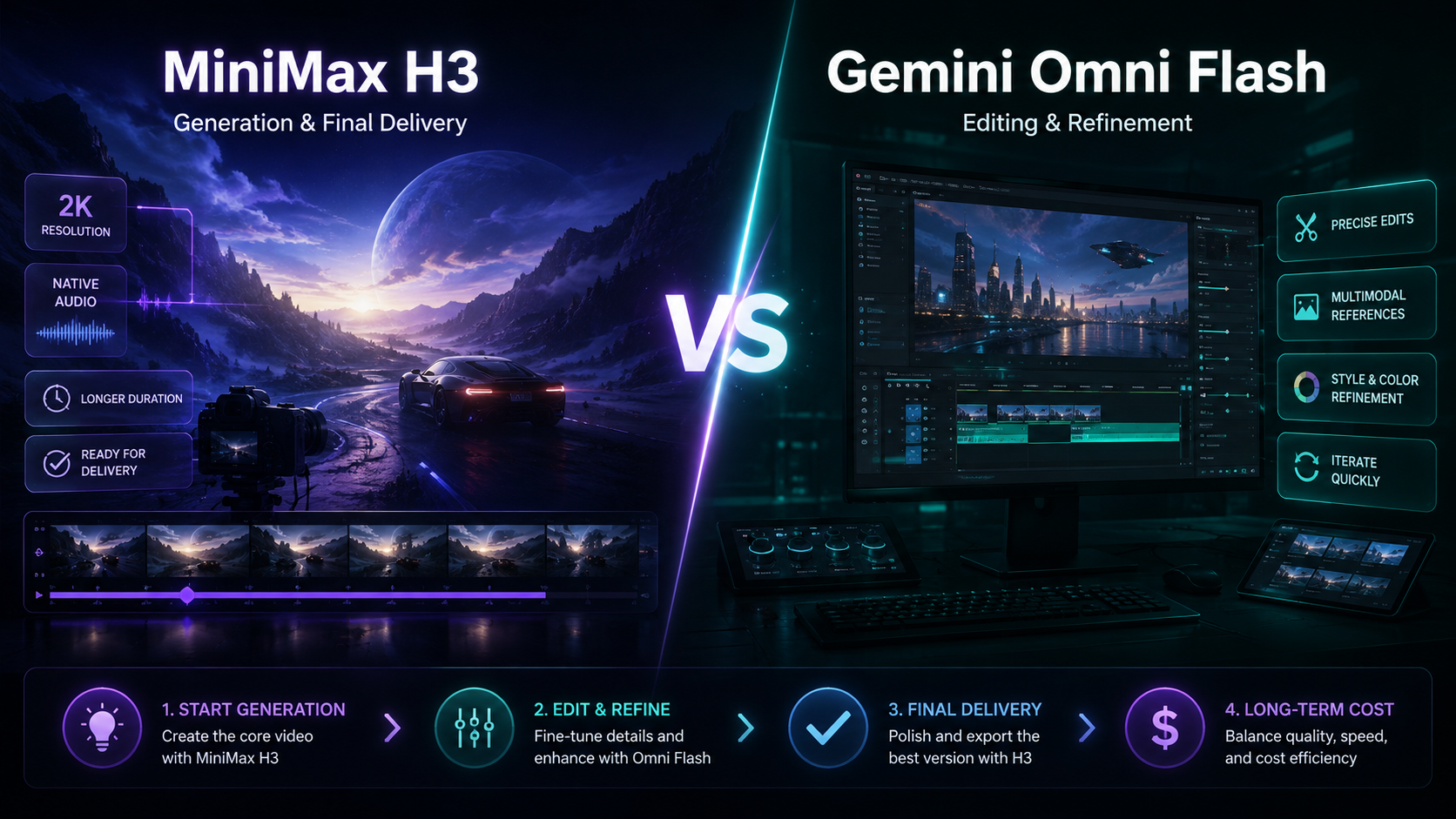
One-sentence answer: If you're redesigning a video generation workflow, it's probably not a simple either/or — it's "different tools for different stages." MiniMax H3 fits better for generation and final delivery; Gemini Omni Flash fits better for the editing and refinement stage in between. Here's how that conclusion breaks down.
Split the big question — "which one should I use" — into four progressive sub-questions: which one to start generation with, which one to use for editing and refinement, which one to use for final delivery, and which one costs less to maintain long-term. Once you've answered these four, how to structure your own project becomes pretty clear.
Generation stage: which one should you start with?
Conclusion: If you need higher resolution or a larger multimodal reference set, start with MiniMax H3. If you just want to quickly validate a creative direction and resolution isn't a concern, Gemini Omni Flash gets you there faster.
MiniMax H3 natively supports 2K output and can combine up to 9 images, 3 video clips, and 3 audio tracks as references in a single generation, folding character, camera movement, and sound style into the result all at once. Gemini Omni Flash currently tops out at 720p, with a reference cap of 7 images plus 3 short video clips (3 seconds or less each), and it doesn't yet support audio references — so if your concept needs an audio clip to guide voice tone or rhythm, H3 is currently the only option at the generation stage. On the flip side, Omni Flash's generation speed and lighter reference requirements make it better suited for "just get a rough draft out to see if the direction works."
Head-to-head test: the same prompt, run on both
A brushed titanium wristwatch rotates slowly on a black glass surface under a single overhead softbox light. The camera performs a slow orbit, revealing the dial's texture, the sapphire crystal reflection, and the metal link bracelet, with a macro focus pull from the dial to the crown near the end. Studio background, high-end product commercial style, with a subtle ambient hum and a soft mechanical click as the crown catches the light.
Observation notes: Native 2560×1440 (2K) at 24fps. Tight macro composition, with the camera doing a smooth low-angle half-orbit; dial markers, sapphire crystal reflections, and the brushed metal bracelet's texture all stay clearly legible even at close range. It closes with a focus pull to the crown as instructed, with a strong lens-flare catch-light, and even the small print around the dial's edge stays mostly readable in the tight framing. Camera movement and the ending both track closely with the prompt's direction.
Observation notes: 1280×720 (720p) at 30fps. The composition is noticeably wider — the whole studio setup (softbox light, turntable stand) is visible in frame, a more literal read of "studio background" than a tight product close-up. The watch design also added two chronograph-style pushers that weren't specified in the prompt — an unrequested design choice. Given the native 720p resolution, dial texture and marker edges are noticeably softer than the H3 result, but it still closes with a macro pull to the crown, brand engraving visible, so prompt-following is on-target — the gap mainly shows up as reduced detail sharpness from the lower resolution.
Editing and refinement stage: which one should you use to polish it?
Conclusion: For scenarios that need several rounds of back-and-forth revision, Gemini Omni Flash is the smoother tool. For a single clear instruction with no multi-turn conversation needed, MiniMax H3 handles it just as well.
Editing and refinement is Gemini Omni Flash's core selling point: through the Interactions API, it supports conversational multi-turn editing — after generating a version, you can say "make the lighting warmer" or "swap the product for blue," and the model remembers the context and only adjusts the part you mentioned. Google officially compares this experience to "Nano Banana for video." Right now a session reliably supports stacking about 3 rounds of edits before context may start to degrade — Google describes this as a current deployment limit, expected to keep improving.
MiniMax H3's instruction-based editing takes a different approach: give one clear instruction, the model executes it, and everything else stays untouched — better suited to a single targeted revision rather than a workflow built around multi-turn conversational memory. If your workflow essentially involves a client asking for repeated changes live on a video call, Gemini Omni Flash's editing experience currently fits that need more closely.
Head-to-head test: the same edit instruction, applied to the same clip
Change the watch face from silver to a deep navy blue, and make the overall lighting slightly warmer.
Apply this instruction to each model's own version of the watch clip generated in the previous test, and compare the results:
Observation notes: Framing, camera path, and the lens-flare position on the crown are identical to H3's original generation — the only change is the dial color, from silver-grey to a deep navy. The bracelet, crystal reflections, and camera movement all carry over unchanged. A clean, single-attribute edit that matches the instruction closely.
Observation notes: The dial color change to navy is accurate here too, and the turntable's rim-light shifts from a cool teal to a warm amber tone — a solid, concrete read of "make the lighting slightly warmer." However, the metal bracelet also shifted from silver to a gold/rose-gold tone, which wasn't part of the instruction — an unintended side effect outside the requested scope. Worth flagging separately: this exported clip comes in at 2560×1440/24fps, well above Omni Flash's native 720p generation resolution — this was traced back to an incorrect parameter selection during this specific test run, not a reflection of Omni Flash's actual default output spec. The visual content is still useful for judging the edit itself, but the resolution number here shouldn't be read as representative of Omni Flash's default editing output, and it doesn't change the 720p conclusion from the generation-stage test above. Worth re-running with the correct settings to get a representative resolution reading for the editing stage.
What these two tests are meant to verify: Both conclusions above were built on published specs and documentation — 2K vs. 720p is a spec-sheet number, and "conversational editing is smoother" is Google's own product positioning. In practice, the resolution gap is indeed visible to the eye, and both models followed their edit instructions accurately overall. What's more notable is that Omni Flash's edit introduced one unrequested side effect (the bracelet color change) — a reminder that "only change what you asked for, leave everything else untouched" doesn't always hold perfectly in practice. This round of testing also surfaced a separate lesson: editing tests are sensitive to parameter settings, and a wrong setting can produce a resolution reading that isn't representative — worth double-checking your generation settings and testing more than once before relying on the results in production.
Delivery stage: which one should close out the project?
Conclusion: When delivery has a hard resolution requirement — large-screen playback, print extensions, upscale-and-crop workflows — MiniMax H3 is currently the safer choice.
This one comes back to resolution again: Gemini Omni Flash currently only offers 720p, and Google's own documentation acknowledges this is a genuine limitation for large-screen or premium brand work, where you'd need to move up to the significantly more expensive Veo 3.1. MiniMax H3 natively offers a 2K output path and a longer duration ceiling (15 seconds vs. Omni Flash's current 10-second cap), making it a better fit for closing out the delivery stage. If your delivery standard is social feed or vertical short-form content that never gets scaled up, 720p is plenty, and this factor stops being decisive.
Long term: which one costs less to maintain?
Conclusion: Looking at unit price alone, Gemini Omni Flash is cheaper for short clips. Looking at technical-stack control and vendor lock-in risk over time, MiniMax H3 has the edge.
Gemini Omni Flash bills by output second, at roughly $0.10/second (720p), with no free API tier — a 5-second clip runs about $0.50 — but it is tied to Google's ecosystem through the Gemini API, AI Studio, and Vertex AI, with no public open-weight plan. This independent MiniMax H3 service uses one-time credit packs that never expire and calculates usage from the selected settings: 3 credits per output second at 768p or 5 credits per output second at 2K, with reference-video duration charged at the same rate and 2 additional credits for each image beyond five. A standard 5-second 2K generation without a video reference therefore uses 25 credits, while longer or reference-heavy jobs cost more. Separately, MiniMax has released H3-Base checkpoints for local deployment through frameworks such as SGLang, vLLM, Diffusers, and ComfyUI, although the full official 2K pipeline still depends on hosted components. Long-term cost comparisons should account for both live service pricing and vendor dependence rather than treating one example generation as a fixed universal price.
Quick Reference Table
After going through the four sub-questions, here's a compact table for direct comparison:
| Category | MiniMax H3 | Gemini Omni Flash |
|---|---|---|
| Status | Officially launched (July 31, 2026) | Public preview |
| Duration | 5–15 seconds | Currently up to 10 seconds |
| Resolution | Native 2K | Currently 720p only |
| Core strength | Generation specs, reference capacity, deployment freedom | Conversational multi-turn editing |
| Reference inputs | Up to 9 images + 3 videos + 3 audio clips | Up to 7 images + 3 short video clips, no audio reference |
| Open weights | H3-Base released for download | No open-weight plan |
| Pricing | Credit packs; 25 credits for a standard 5-second 2K generation, variable by settings | About $0.10/second (720p) |
FAQ
Can these two models be used together?
Yes, and that's what a lot of teams actually do: use Gemini Omni Flash for fast conversational iteration on creative direction, then use MiniMax H3 to generate the final high-resolution delivery version once the direction is locked in.
Will Gemini Omni Flash support higher resolution in the future?
Google has only committed to extending duration so far; there's no published roadmap for 1080p or 4K. If you need higher resolution right now, the alternative within Google's ecosystem is Veo 3.1.
Can MiniMax H3's open weights fully replace the official hosted 2K result?
Not fully. The downloadable H3-Base checkpoint itself outputs at 768p; the official full 2K regeneration pipeline depends on MiniMax's hosted components, which haven't been open-sourced.
Does Gemini Omni Flash's conversational editing have a turn limit?
Currently a session reliably supports stacking about 3 rounds of edits before context may start to degrade. Google describes this as a current deployment configuration limit, expected to keep improving.
Can both models be tried for free?
MiniMax H3's first generation is free with no card required. Gemini Omni Flash has no free API tier, but it can be tried through Google AI Studio's development testing quota.
Summary
Breaking "which model should I use" into generation, editing, delivery, and long-term maintenance cost, the answer isn't binary: MiniMax H3 is more solid on generation specs, reference capacity, and deployment freedom, making it a good fit for the start and end of a workflow. Gemini Omni Flash has a clear edge in conversational editing, making it a good fit for the refinement stage in between. If your project can accommodate different tools at different stages, that's probably the most practical setup right now. If you can only pick one, go back to the four sub-questions above and see which stage your project gets stuck on most often — the answer follows from there.
If you want to start testing with MiniMax H3, you can generate your first video for free on the MiniMax H3 website — no card required to start.
Sources and verification
- MiniMax H3 official release
- Google AI official Gemini Omni Flash documentation
- Google DeepMind Gemini Omni Flash model card
Specifications, prices, and availability can change. Check the linked first-party documentation before making production or purchasing decisions.